Application Tips
Strengthen Your Scholarship Application
Explore these tips to learn how to strengthen your scholarship application.
ignore
tgsfgsg
Complete the Application in 3 Steps
Once you set-up your profile in our application system, you will have to complete 5 steps BEFORE you can submit your scholarship application for consideration by the College Fund:
· Scholarship Application
· Extracurricular Activities
· Honors and Distinctions

In the first step, Scholarship Application, you will provide academic information such as your grade point average (GPA), school, major, and more. This is the section where you will answer the reflection questions, which are important for your overall application score.
While you work on the Scholarship Application step, you can save your work as a “draft.” When you have completed the Scholarship Application step and proof-read all your responses, you will click “mark as complete,” and then return to the application dashboard to complete the remaining steps.
In the remaining steps, you will add information about yourself, such as activities you participate in and any awards or distinctions you have received.

In the Extracurricular Activities and Honors & Distinctions steps, you will click on the green “+New Item” button to add a new entry. Under these sections, add as many new items as you like. You must add at least one item in each step. You can save individual entries as “draft.” Please note that the application will not let you submit if you have any entries saved as “drafts” when you go to submit. If you make a mistake, entries can be deleted using the “delete” button. When you are done with all your entries in either step, click the white “close” button at the top right, and that will take you back to your application dashboard.
The last section, Resume, is optional – but we encourage you to complete it if you are interested in internships or career development opportunities.
Once you complete each of these steps and have reviewed all of your responses, you can return to the application dashboard and click the green “Submit Application” button. The green submit button will only be highlighted and clickable if you have completed all the application steps. You must click on the green “Submit Application” button to have your application reviewed by the College Fund and to be considered for scholarships.
*** Warning – you will not be able to change your application once it has been submitted! ***

We are here to support your success. Please email us at scholarships@collegefund.org, or give us a call at 1-800-987-3863 from 8am to 4:30pm (MST), Monday through Friday, if you need assistance with your application.
Reflection Questions
The Scholarship application has three reflection questions that resemble mini essays.
These questions give you a chance to share your story. The reflection questions prompt you to discuss three subjects: an obstacle that you have overcome to get to where you are now; your educational goals and how this scholarship will help you achieve them; and how your education will help the Native community.
We recommend that you type out your responses to the reflection questions in a Word document or similar text editor. This way you can edit freely and utilize spellcheck or grammar check functions.
To enhance your responses, start by creating an outline of your thoughts and initial answers to each question. The outline does not need to be exhaustive, but it will allow you to start organizing your thoughts about the questions. You will need to choose your words carefully, as there is a limit of 300 words per question. It is very important that you think deeply about the questions and provide a thorough responses. As always, don’t forget to check your grammar and spelling!
For scoring, the reflection questions count heavily compared to other sections of the application. A high scoring essay will be clear, complete, and compelling. Thoroughly answer each question with the details of your unique story in a way that will engage reviewers. Pay attention to the help text below each question text box for additional guidance.
Formatting & Editing
These tips for formatting, editing, and proofreading make sure your application is PREPPED for excellence. You can apply these tips throughout your application.
Start with the basics:
- Creating descriptive and appropriate responses
- Writing in complete sentences
- Ensuring that answers flow cohesively
- Using correct grammar
In your Reflection Questions, Extracurricular Activity entries, and Honors & Distinction entries, use full sentences that allow your personality and passions to come forward. For example, if your educational goal is to complete a bachelor’s degree in early childhood education and teach on your reservation, it is recommended that you respond with a full sentence like the one below:
It is my dream to complete my bachelor’s degree in early childhood education in order to teach the next generation of leaders on my reservation. I believe that foundational life skills can be taught at a young age, and I want to be a part of empowering these learners through my degree.
Do not answer the reflection questions with bullet points or fragments. It is not recommended to format your answer like this:
- Educational Goals: B.A. in early childhood education, plan to teach on the reservation.
If you need help editing, just remember PREPPED.
PREPPED stands for Prepare, Readability, Every Question, Punctuation and Grammar, Passion, Examples, and Double Take. Here’s how to be PREPPED on your application:
- Prepare: Gather necessary information prior to starting the application. Prepare your response by thinking critically about the questions and creating outlines when appropriate.
- Readability: Do your answers flow? Are the sentences and thoughts laid out in a cohesive way that leads the reader through your answer from start to finish? Are there any parts that sound awkward or out-of-place?
- Every Question: Did your answer completely address a every part of the question?
- Punctuation and Grammar: Is your grammar correct? Did you place commas in the correct spots? Do your possessive nouns include the apostrophe properly? Have you used the correct form of commonly misused words, such as they, they’re, their, and affect or effect?
- Passion: Read over your words and ask yourself if your passions are evident in your writing. Are you writing something because you think it is what the readers want to hear or are you genuinely passionate about your goals and dreams?
- Examples: Did you provide specific examples to better explain your statements? Are these examples relevant to the question and the point you are trying to make?
- Double Take: Once you have gone through the finer details of editing and proofreading, ask a friend, instructor, tutor, or family member to read through your responses. Ask them to use the PREPPED checklist. After they have read them over and provided feedback, edit your answers once more to reflect any changes. Then go through this checklist one last time.
Congratulations! You are now PREPPED and your application responses are ready for submission!
Application Photos
The American Indian College Fund may use your application photo in donor reports, direct mail appeals, and marketing opportunities. Students will need to upload a photograph in their application each year.
Try to focus on the following things when selecting a photo for your application:
- Your photo or headshot should feature you above all else
- Your face should be clearly visible (avoid ball caps, sunglasses, or heavily pixilated or dark images)
- Headshots are preferred but full-length photographs are acceptable
- Traditional regalia is encouraged but not required
- Please have someone else take the photo and avoid selfies
- Consider the lighting. It is better to have light in front of you than behind you
- Don’t forget to SMILE!
Proving Descent
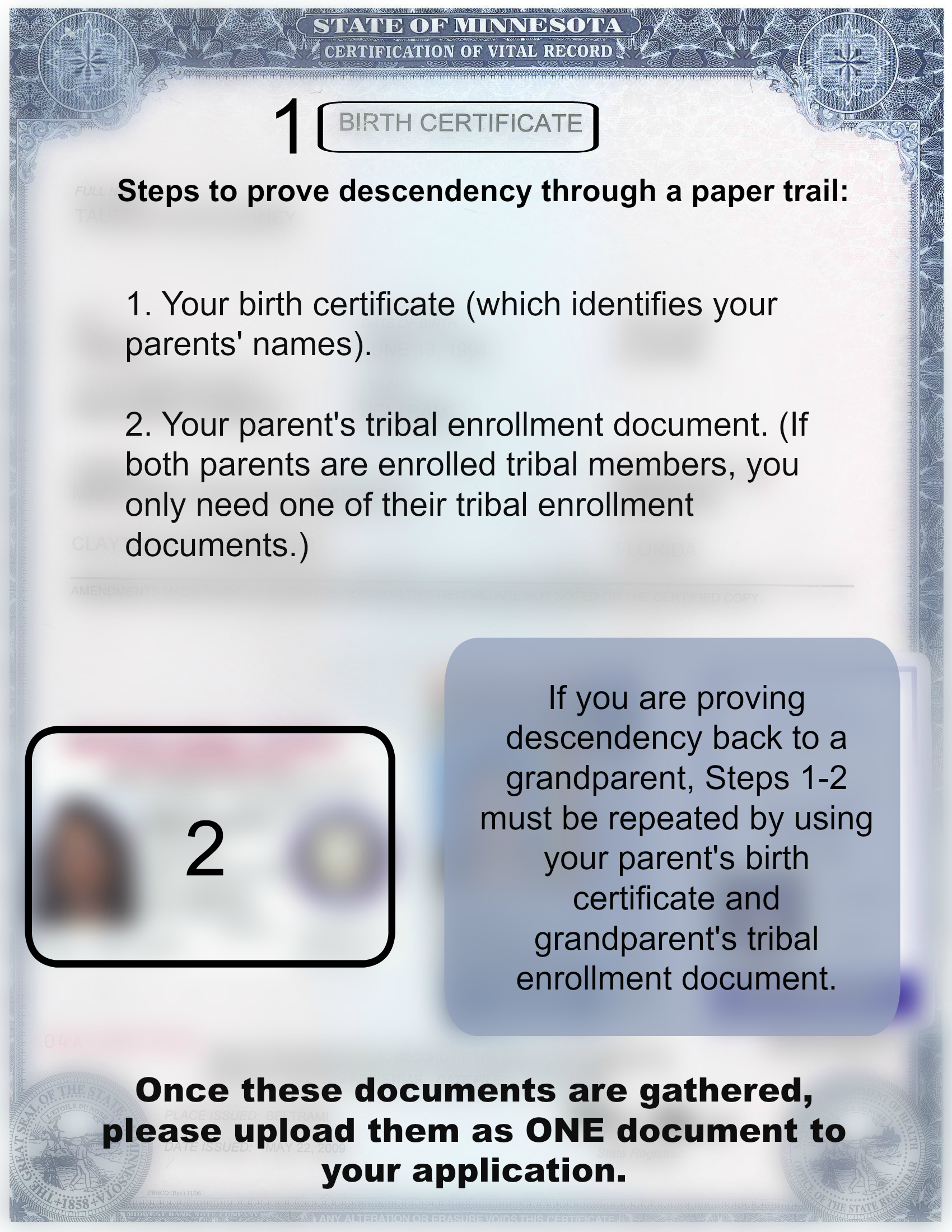
For students who are not enrolled tribal members themselves but are able to prove that their parents or grandparents have tribal enrollment, the following is very important.
The graphic below illustrates an excellent example of how to prove descent through a paper trail:
Examples of tribal documents may include:
– Official letter from the tribe stating the enrollment status of the parent and/or grandparent;
– A copy of the Tribal ID card;
– CIB (Certificate of Indian Blood)
Enrolling in Your Tribe
Each tribe has their own unique requirements and process for becoming an enrolled member. The best first step is to reach out to your tribal government to learn more. If you need help contacting your tribe, visit the Bureau of Indian Affairs (BIA) website at https://www.doi.gov/tribes/enrollment to learn more.
As each process is unique, and tribes of differing sizes and administration have varying capacities to handle enrollment requests, you shouldn’t assume that your request will be processed quickly. Many smaller tribes with limited staff are completely unavailable to complete this work due to seasonal subsistence activities and other cultural practices.
Extracurricular Activities
Extracurriculars are any activities that you do outside of your required schoolwork. This includes, but is not limited to, traditional and cultural activities, clubs, sports, volunteering, work/employment, faith-based activities, community-based activities, and hobbies.
Extracurricular activities set you apart from other applicants and increase your chances of receiving a scholarship. For these reasons, we encourage you to add a complete history of your extracurricular involvement.
Don’t be discouraged if you do not have time for sports or a dozen bake sales. The American Indian College Fund encourages you to think outside the box when it comes to your time spent away from school work. Many of our students are nontraditional students, returning to school later in life when they have full-time jobs and families. For this reason, employment and family duties can be Extracurricular Activity entries on your scholarship application. More entry types are:
- Volunteer and/or service-related activities
- Athletics
- Student Government
- Academic and Professional Organizations
- Multicultural Activities
- Employment
- Work Study
- Family-related activities
Updating Your Profile & Application
Applicants can view their profile and scholarship application whenever they wish. Students will be able to update their profile as needed. However, the scholarship application cannot be edited once it is submitted.
Profile – It’s important to keep your profile information up to date in our system. If your contact information changes, it is your responsibility to update your email and phone number with us. This is important, as we will notify students of awards, opportunities, and next steps via email.
Full Circle Scoring Insights
What happens to my application when I submit it? How will my application be scored?
When you click “submit,” your application is stored securely in the online application system until scoring begins. Students who submit their application between February 1 and May 31 will have their application scored by the end of July.
Applications are scored by independent reviewers who have experience in Native higher education. Each application submitted between February 1 and May 31 will receive three scores by three separate reviewers. We then take the average of those three scores to assign the application its final score. American Indian College Fund staff members do not score the applications.
For scoring consistency across the applications, all readers use a rubric system to determine how many points to allocate for various portions of the scholarship application. Higher scores are more likely to receive a scholarship. As a merit-based scholarship program, the rubric scores applications based on thoughtful responses and a student’s ability to demonstrate merit. The reflection questions are the highest scoring portion of the application. There is also a preference for students attending tribal colleges and alumni of tribal colleges.
Typically, scholarship awards are determined by the end of July. You can log in to your online application profile at any time to see if you have received an award. If the word “pending” appears beside the application, that means your application is still under review, so keep checking back!
We hope this has been helpful in outlining how scholarship applications are scored. As always, if you have any questions or concerns, please feel free to contact us by email or at 800-987-3863.
If you have additional questions about applying for scholarships, be sure to read through our Frequently Asked Questions.