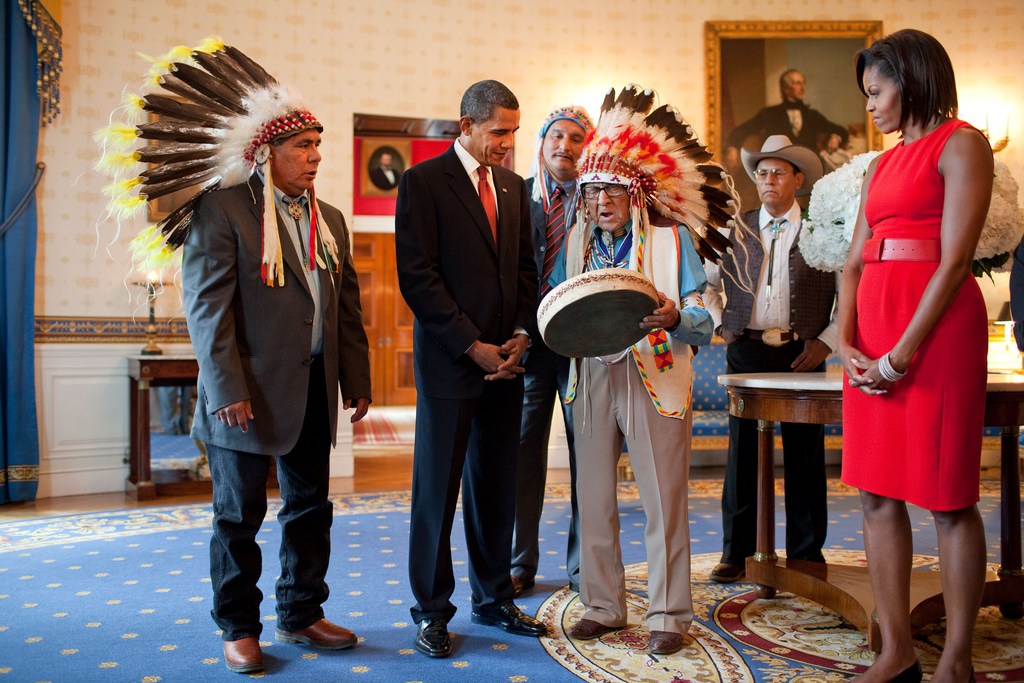
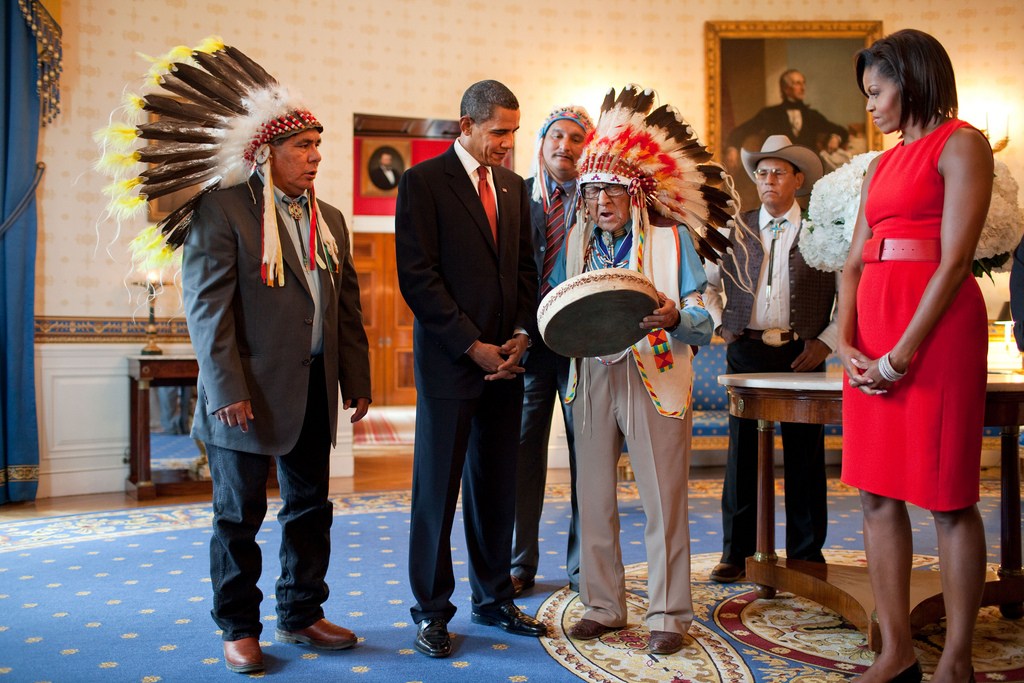
Presidential Medal of Freedom recipient Joseph Medicine Crow shows a drum to President Barack Obama and First Lady Michelle Obama during a reception for recipients and their families in the Blue Room of the White House, August 12, 2009. (Official White House photo by Pete Souza)
Joseph Medicine Crow, the last living war chief of the Crow Tribe of Montana who was a renowned Native American historian and anthropologist, has died at age 102. He was the last living person to have heard direct testimony from people present before the Battle of the Little Bighorn in 1876. His step-grandfather, White Man Runs Him, was one of six Crow scouts for George Armstrong Custer, and died when Mr. Medicine Crow was 11 years old.
Mr. Medicine Crow received the Medal of Freedom, the highest civilian honor in the United States, from President Obama in 2009, for his service during World War II, as well as his work as an historian authoring works of Native history. He was the first member of his tribe to earn a master’s degree.
Mr. Medicine Crow was a Linfield College graduate from McMinnville, Ore., in 1938. He went on to earn a master’s degree in anthropology from the University of Southern California (USC) a year later, specializing in the impact of European culture on Native people. World War II interrupted his education after he had completed his coursework to earn a doctorate degree and just as he had begun to write his dissertation. He went on to serve his country in the war, where he accomplished the four traditional deeds that earn a member of the Crow Tribe the status of war chief, including stealing an enemy’s horse—and in his case, 50 horses, which he took from the Nazi SS in a German camp. In 2003, USC awarded him an honorary doctorate.
In his role as an historian, Mr. Medicine Crow spoke at the United Nations in 1999. He was also a frequent speaker at Little Big Horn College and Little Big Horn Battlefield Museum. During his lifetime he appeared in several documentaries about the battle, and wrote several books, articles, and lectures, for which he is best known for his work about the Battle of Little Bighorn.
Known as the last war chief, the Indian Country Today Network explains how his tribe distinguished this honor for him:
It was on the European battlefields Medicine Crow completed all of the four tasks needed to become a Crow War Chief. As a scout he led several successful war parties deep behind enemy lines; he stole German horses; he disarmed an enemy; and he touched an enemy (counted coup) without killing him.”