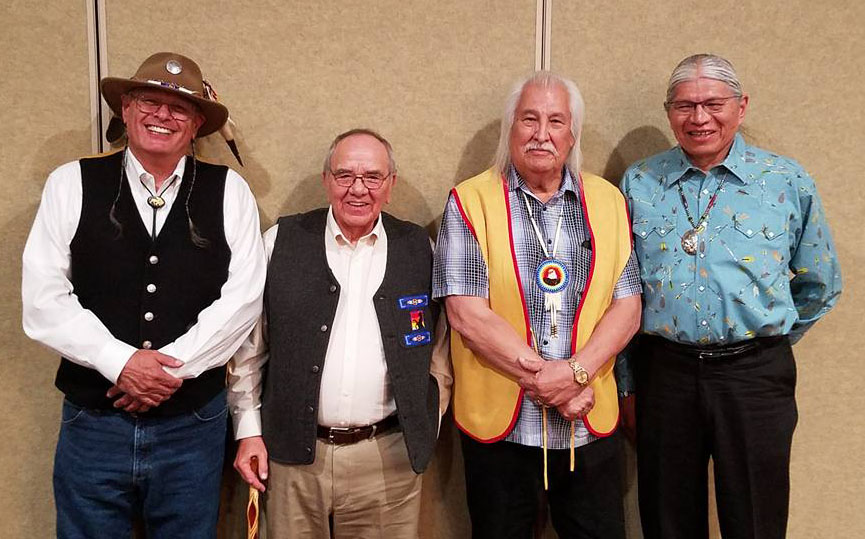
John Gritts, far right, is pictured with several leaders in the tribal college and university movement. From left: Richard Williams, former President of the American Indian College Fund; Lowell Amiotte, former President of Oglala Lakota College; and Lionel Bordeaux, President of Sinte Gleska University, in Rapid City, South Dakota.
John Gritts, a friend and former employee of the American Indian College Fund, passed on October 19. As a proud citizen of the Cherokee Nation, John honored his identity and experiences by being a lifelong advocate for Native higher education and tribal colleges. He credited his parents and grandparents for his own education, making it possible for him and his four brothers to go to school. John paid that education mindset forward for the entirety of his career to make it possible for countless thousands of Native students to attend college by helping them negotiate the complicated and sometimes confusing financial aid process.
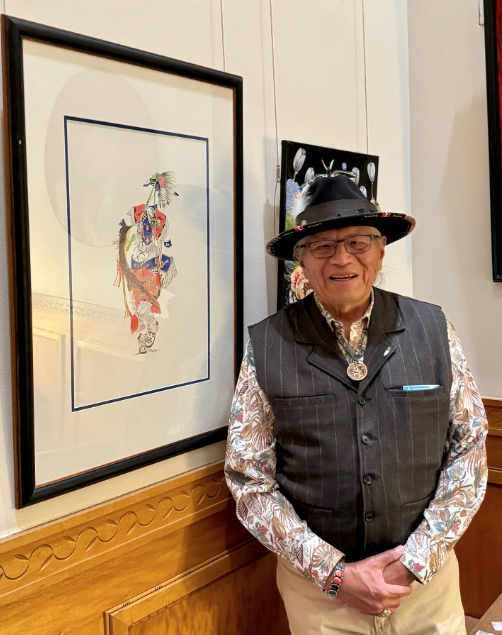
John Gritts
A talented artist, John was a student at the Institute of American Indian Arts (IAIA) in Santa Fe New Mexico from 1966-68. He started his career supporting students serving in the financial aid office at Black Hills State (College) University in 1973. Early in his career, John not only supported students at BHSC, but he also helped tribal colleges as they established their own financial aid programs, beginning his lifelong commitment to helping TCUs. He later worked for the American Indian College Fund starting in 1997. John said in an interview “I just thoroughly enjoyed that, hearing stories and hearing how tribal colleges and universities were doing. To me they just keep moving to the next level. They’re cornerstones on the reservations… they do a wonderful job with educating their students.”
After leaving the College Fund in 2006, he joined the staff at his alma mater, IAIA, as director of admissions, records and enrollment, before joining the U.S. Department of Education in 2008 where he served as a management and program analyst for the U.S. Department of Education’s Federal Student Aid, Minority Serving and Under Resourced Schools Division until his retirement. After accepting that position, he often shared the joke that he attended an American Indian Higher Education Consortium board meeting and said, “I am from the government…and I am here to help you.” The tribal college presidents in attendance laughed since they had all heard that line before from federal workers.
He received numerous professional awards throughout his lifetime, including honorary doctorate degrees from Bacone College in Oklahoma and Sinte Gleska University in South Dakota, the American Indian College Fund’s first-ever Lifetime Achievement Award in 2017 in recognition of his ongoing service in supporting and furthering the missions of tribal colleges and universities throughout his career, and the National Indian Education Association (NIEA)’s Elder of the Year award in 2010.
John said at the time, “When I learned about the award, I was totally shocked. When you are doing your job, you are not looking for these things. When you learn about tribal colleges and universities, you can always be an advocate.”
“Having started my career at Black Hills State in the student services and financial aid field, you can’t help but know or see what student need is.” At the time Sinte Gleska University and Oglala Lakota College, both tribal colleges in South Dakota, had not yet earned their accreditation, so he also worked with those institutions, traveling to their campuses and providing their financial aid services.
John was an associate there for six years before his promotion to the Director of Financial Aid position in 1980. There was political turmoil in South Dakota with the American Indian Movement at that time, and he was honored that Black Hills State took a chance by hiring an American Indian. He said, “They gave me an opportunity because I can communicate.”
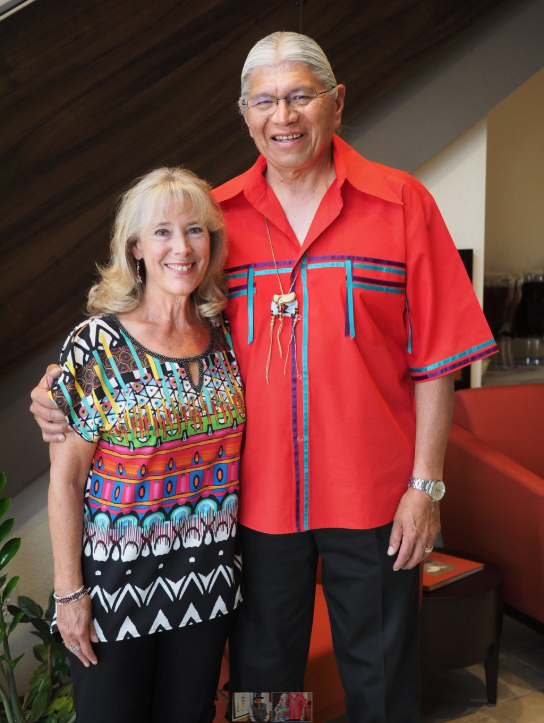
John Gritts with wife Page Lambert.
John was a storyteller and loved sharing many stories throughout his career. After receiving the Lifetime Achievement Award from the College Fund, he told the story of a rancher who came to see him about financial aid for his daughter. He explained the process to the man and what she qualified for, and concluded he looked forward to her being a student at Black Hills State.
“Oh, she’s not going here. She’s going to South Dakota State,” John recounted.
“I told him he should have spoken with the officer there, but he said he was told to talk to me because I would explain it better.”
In the early days of the College Fund John shared a cramped office with many staffers, one phone line, and one e-mail account. “We were always breaking circuits,” he said. In that close environment, he said, “You can’t help but learn. David Cournoyer taught me passion on behalf of what we do for students and our colleges. I will never forget our first gala—how touching it was to hear our students’ stories when they spoke. And it is great seeing the light come on with our students, whether they are young or middle-aged or old, and decide they need an education.”
“The best time, of course, is graduation, whether it was at Black Hills State or at a TCU. When the students walk across the stage and then say thank you; that is all it takes. You cry like a baby.”
John said his work “…was and isn’t a job. It’s doing what you like.” In an interview with Tribal College Journal he said, “I am going to say it was a fun life, and I say that in all good heart because I enjoyed my career.” He continued his commitment to education with his own family just as his grandparents and parents had done with him. He once said one of things he was most proud of was that three of his sons went to tribal colleges and two graduated. “And the one that didn’t, Trevour, the Creator took him home before he could graduate.”
After retirement, John continued his deep commitment to students and tribal communities by supporting the annual SKC conference, where TCUs gather to share, learn, and advocate for their professional growth. Cheryl Crazy Bull, President of the American Indian College Fund, a friend and colleague of John’s since the 1980s, said, “John’s legacy lives on. His good will, his humor, and his kindness are what we will all remember about him. We pray for his spirit to have a good journey and for strength for his family.”
The College Fund extends its condolences to his wife, Page Lambert, his children, grandchildren, and extended family on their loss.
Further Reading and Viewing
John Gritts spoke with Tribal College Journal in 2020 for its Current Reflections podcast about tribal college family values. You can listen to that here.
Read about John’s career in his own words in “Being a Fed,” published in the November 9, 2014, issue of Tribal College Journal.
John Gritts talks about how his art remains unfinished because of the unfulfilled and broken promises to Native people with 9News.
John Gritts was an integral part of the American Indian College Fund’s work, including its messaging. Hope on the Rez, 2008 video.