by Alex Stribling, Preschool Teacher, Northwest Indian College Early Learning Center
Do you hear those sounds? They are the sounds of birds, bugs, and children playing! It is spring, and we are fully experiencing the new season at Northwest Indian College’s Early Learning Center.
One of our goals in our preschool room is to keep children exploring their indigenous roots through science, technology, engineering, and mathematics (STEM) education while having fun. April has brought us many showers, but we have managed to keep children excited to learn with so many of their new tools, made possible by our Early Childhood Education STEM Initiative grant, funded by the American Indian College Fund.
Discovering the variety of animals and insects in our classroom is something that the children have enjoyed immensely. Coming into school as a three-year-old, a child’s knowledge of animals may be limited to a few farm animals or one type of dog. These animal figurines, which represent the fauna located around the Salish Sea, have so much realistic detail to them. Children cannot help but ask, “What kind of bird is this? What sound does it make? Where does it live?” The children are learning there are many more different kinds of animals, birds, and insects than the ones they have in their existing vocabularies.
The children have also been learning about life cycles of bugs, birds, and animals. Feeding their minds with natural growth and showing them in an accessible way has changed how they address an animal or bird in nature. They have started paying attention to what stage a creature may be at in its life cycle, commenting, “That’s a baby worm. That bird is full grown!” Teaching this has been thrilling because we can see the children’s vocabularies grow and their understanding deepen, as they retain the information they are learning from the outdoors.
Once we established that there are many types of living creatures, we started to paint them. The children love exploring the different colors that make up their animal as they traced it from a photo. Seeing the various shapes and using numerous colors nearly brought the animals to life as we tried a new medium of artwork!
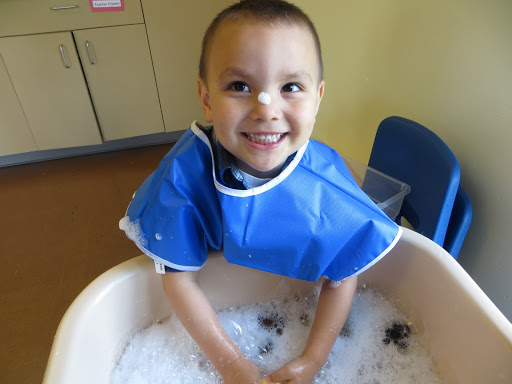
We then studied rivers and fish. In order to teach children about rivers, we had them go fishing one day and wash rocks with soapy water the next. Providing children with hands-on activities that match our place-based curriculum helps them see that what we teach and learn at the Early Learning Center aligns with what they do in their home communities. When you engage children in body-to-brain connections and movement-based activities, they better retain what they are learning. With both, their explorations of Indigenous STEM education are endless!